In and against the imperial state: Talawa at the Cochrane
It was a pleasure today to be at ‘New Directions, Histories, and Adaptations in Black Theatre and Performance’ - thanks to the organisers Tiziana Morosetti and Lennoxx Goddard. The event was partly arranged to honour the legendary theatre-maker Yvonne Brewster, who died last year, so I spoke about how I understand her legacy.
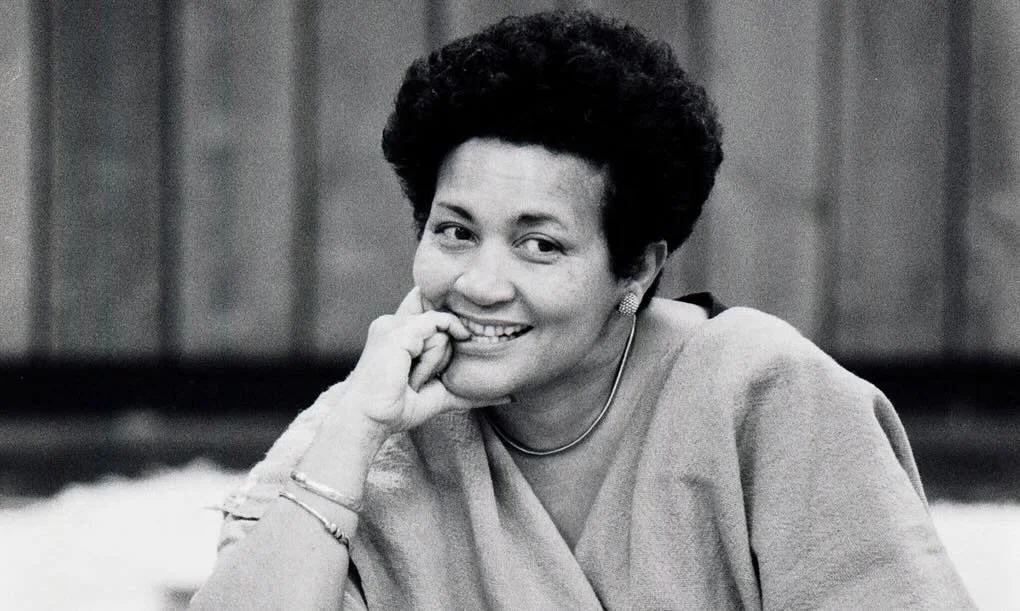
Yvonne Brewster
This paper is about the repertoire that Yvonne Brewster chose for Talawa’s three-year residency at the Cochrane Theatre in London from 1992-94.
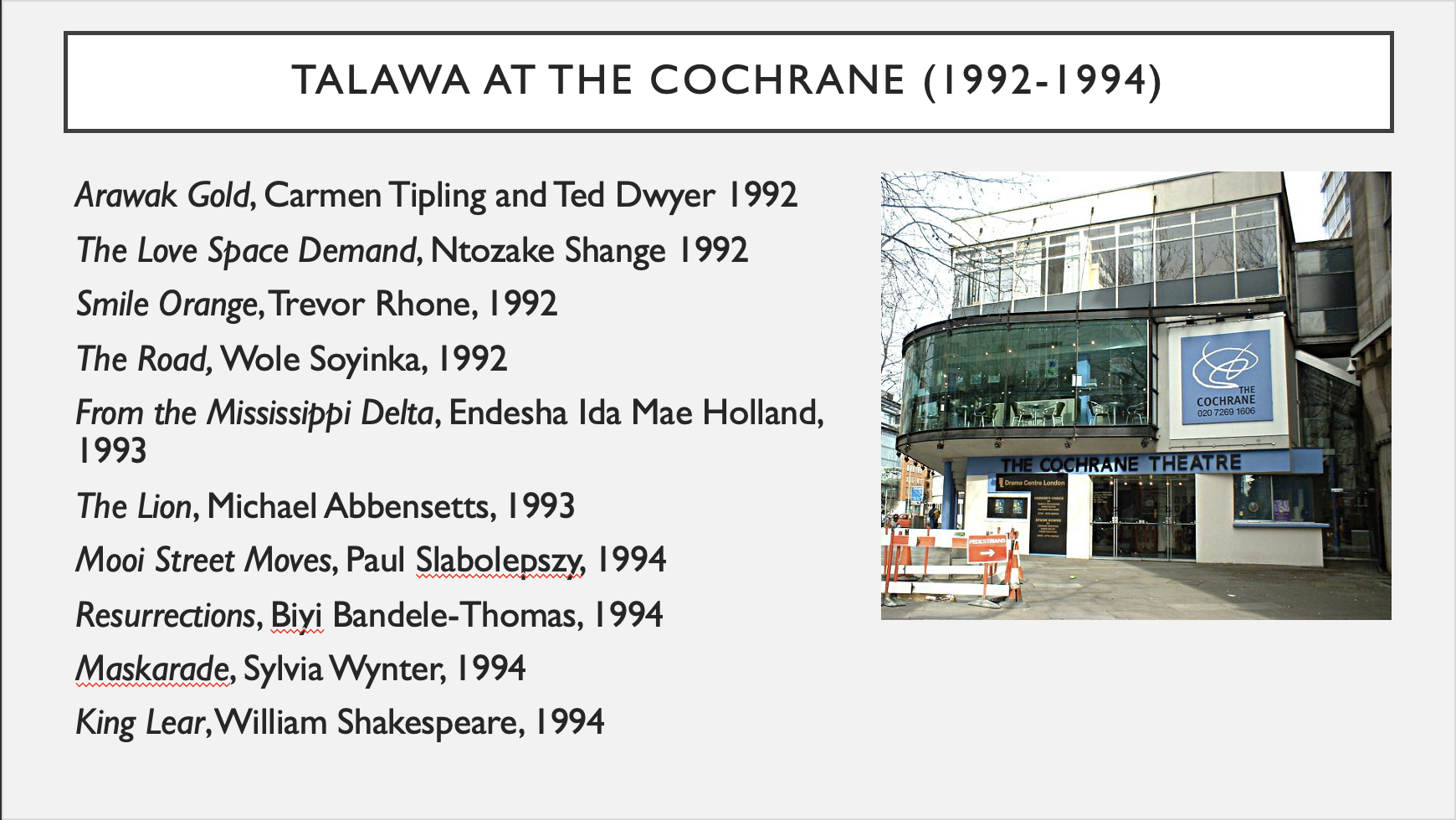
Talwa’s repertoire at the Cochrane Theatre 1992-94
These are the ten plays that Brewster chose. I must immediately acknowledge a debt here to David Vivian Johnson’s historical survey of this period of the company’s work, which I have relied upon a great deal. I should also say that my concern here is to think at the level of repertoire and not about individual plays or productions, and to ask a variant of the question that Stuart Hall enjoins us to keep always in the forefront of our minds: what does this [body of work] have to do with everything else?
Put simply, my answer to that question has two parts.
1) This body of work emerged at a time when Britain’s racial regime was being forced to reconstitute itself in order to legitimate racial order both domestically and at a planetary scale. This is not simply a coincidence. I want to argue that Brewster’s repertoire directly contested not only the de facto racialized segregation of British cultural production at the time, but the colonial basis and ongoing imperial commitments of the British state. The racial regime was reconstructed precisely to foreclose such critiques.
2) The racial regime that was reconstituted during the early nineteen-nineties has found itself in a deepening crisis for the last decade that is, as yet, unresolved. That crisis has been entangled with a crisis of US-led imperialism to which the British state remains, nonetheless, deeply committed. It is therefore timely for us to consider the ways in which artists like Brewster sought both to critique and to offer alternatives to the racial ordering of imperial power, as the crisis of the racial regime increasingly exposes that which it sought to foreclose.
I’ll take you through this in three stages. First, a brief theoretical excursion into the term ‘racial regimes’, then a sketch of the reconstruction of Britain’s racial regime in the early 1990s, and finally a consideration of what I think are three crucial commitments of the repertoire set out here:
· its positional commitment to the standpoint of globalized underclasses,
· its epistemological commitment to vernacular traditions in the colonized world, and
· its political commitment to solidarity between Black and indigenous people.
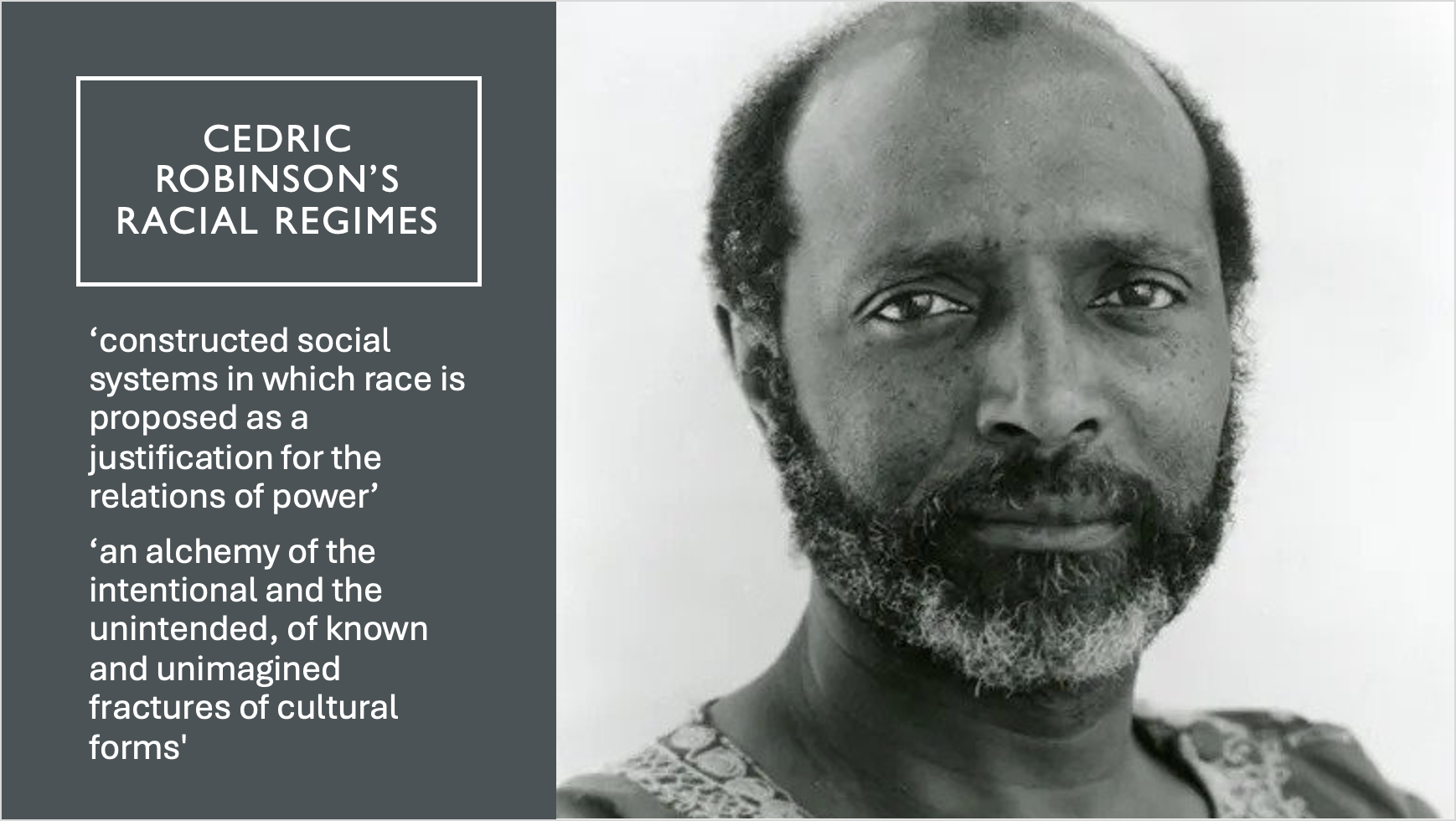
Cedric Robinson’s ‘racial regimes’
Race is, as Stuart Hall put it, a ‘changing same’, a ‘technology for the management of human difference’ in the interests of white supremacy, in Alana Lentin’s definition, that has fulfilled its function by racializing different groups in different ways at different times. The apparent continuity of race depends, in other words, upon its contingency: its capacity to reproduce itself in altering forms.
This is the subject of Cedric Robinson’s last book, Forgeries of Memory and Meaning, an examination of the altering constructions of blackness in north American theatre and film during the early twentieth century. Here, we find an analytical concept essential to tracking race’s changing same: ‘racial regimes’, which Robinson defines as ‘constructed social systems in which race is proposed as a justification for the relations of power’. As I’ve argued elsewhere, Robinson’s conception of such regimes offers a conjunctural framework for analysing the development of racial capitalism.[1] In other words, it seeks to identify the racialized terrain produced by a series of temporary fusions of both long and short-term social, political and cultural dynamics in what Stuart Hall and many others have termed a ‘conjuncture’.[2]
Because of this, although Robinson focuses on social relations within systems that have sufficient solidity and regularity to justify their historical analysis, his engagement with each successive regime consistently emphasizes their instability and capacity for fragmentation and reconstruction. He concentrates primarily on the ‘chaotic’ production of successive racial regimes as ‘unstable truth systems’ or, a ‘makeshift patchwork [‘stitched together from remnants of its predecessors and new cloth’] masquerading as memory and the immutable’.
Theatre companies’ repertories are likewise makeshift patchworks, stitched together from remnants of their predecessors and new cloth, but before we can ask what kind of a world Talawa at the Cochrane’s repertory constructed, we need to consider the wider racial regime into which their work would intervene.
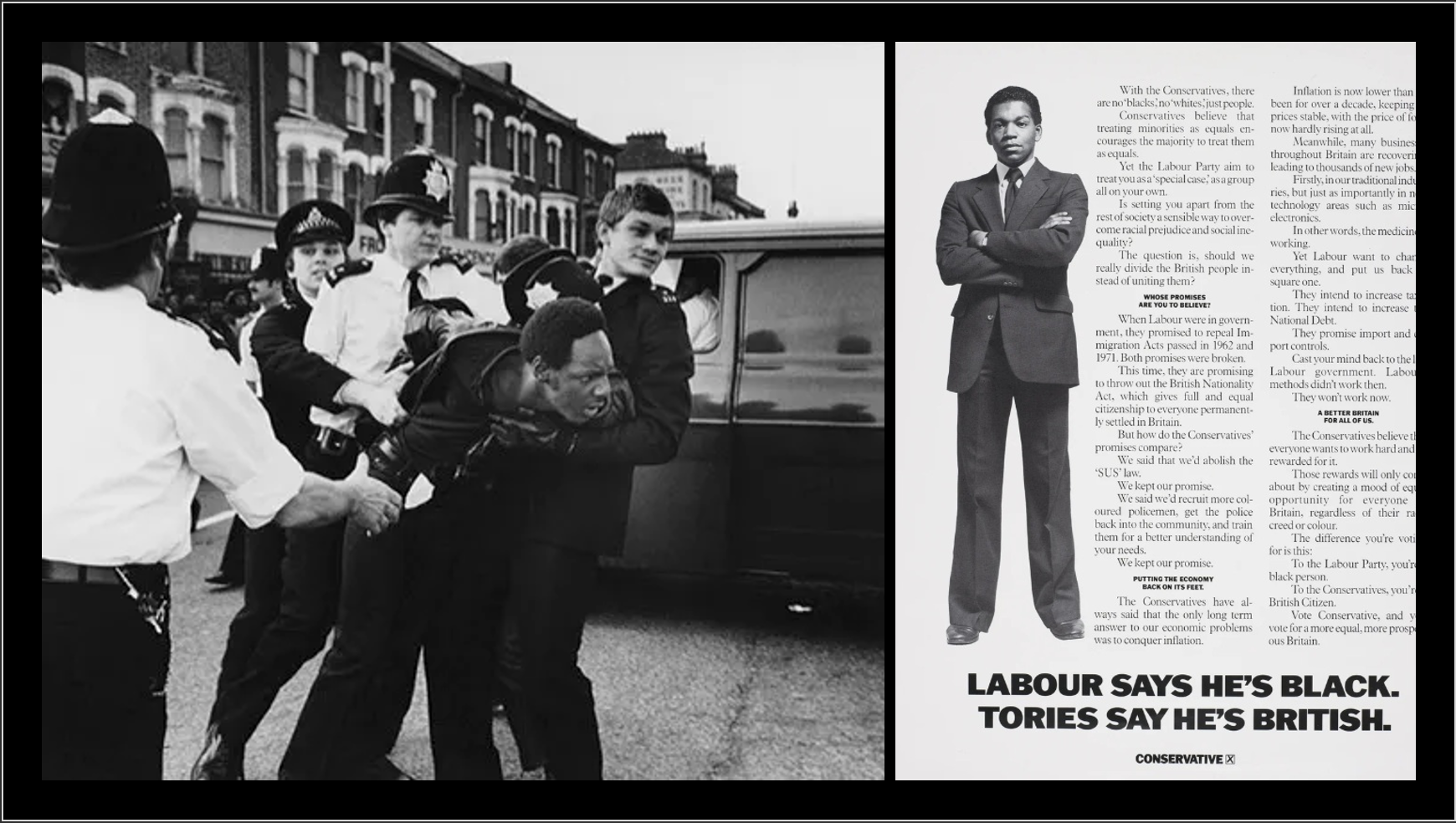
A man is arrested by police during the 1981 Brixton uprising and a Tory election poster from 1983 proclaiming ‘Labour Says He’s Black, Tories Say He’s British’
We are all, I am sure, familiar with the racial politics of Thatcherism. Its central contradiction is represented by these two images, which express its dominant theme of authoritarian state racism (which was, of course, always partly dog whistling to fascists),[3] and its emergent theme of supposedly non-racist conservative nationalism, seen here in a Tory campaign poster for the 1983 election.
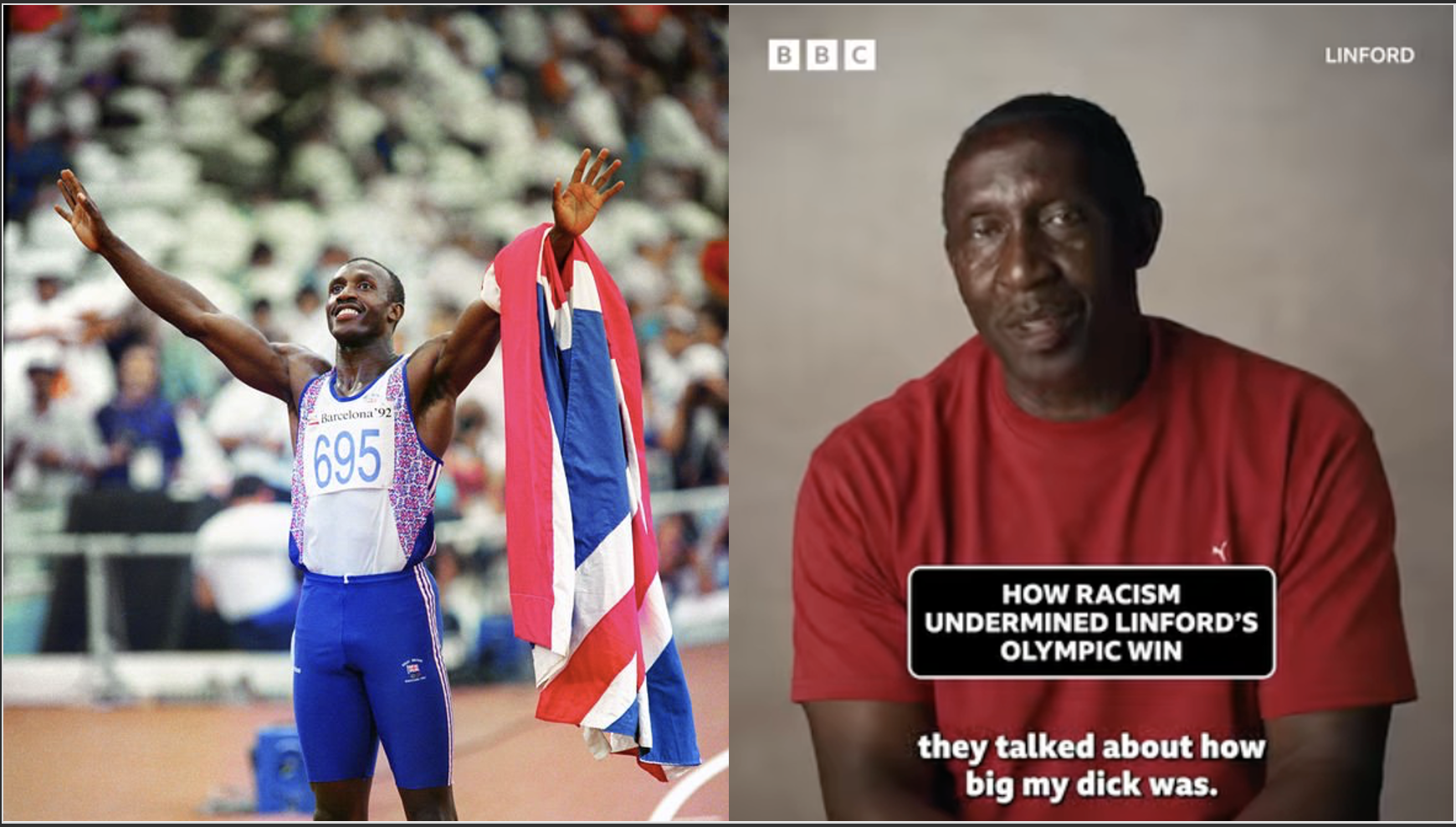
Linford Christie celebrates winning gold in the Barcelona Olympics and reflects on the experience in a 2025 documentary
Jumping ahead to 1992, we find both deep continuities and some important changes as the racial regime of what I term the ‘long white nineties’ begins to take shape. By this point, liberal antiracism has become hegemonic, and therefore what was an emergent theme of the incorporation of certain Black people into the nation has become dominant. Racism persists of course, but increasingly under the guise of what Eduardo Bonilla-Silva calls the ‘apparently non-racial’. This situation is often termed ‘conditional inclusion’, but I think is better explained by Fred Moten’s term ‘incorporative exclusion’.
Moten’s concept can be illustrated by the athlete Linford Christie, a national sporting hero after his success at the 1992 Barcelona Olympics. Christie recently recalled in an interview that the tabloid press responded to that victory by immediately fixating on his genitals with the phrase ‘Linford’s lunchbox’. One effect of this was that white women would literally walk up to him in public and grab his penis. Christie was not conditionally included into the British nation as a result of his success. He was incorporatively excluded after that success. As the actor Daniel Kaluuya memorably said: ‘The reason why they’re doing it is not cos we’ve underachieved’.
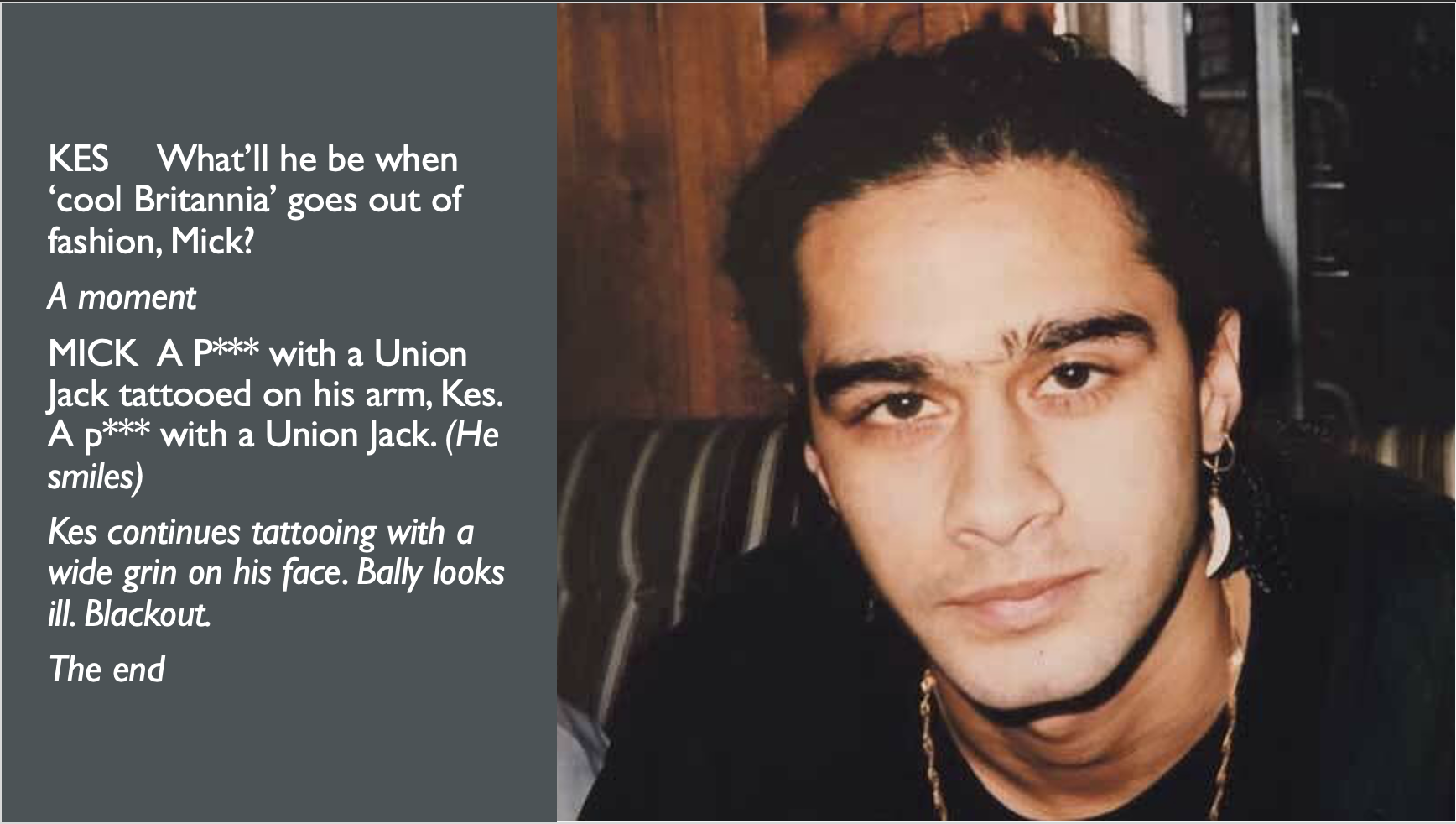
Portarit of Parv Bancil and the final lines of his play ‘Made in England’
Perhaps the most direct and eloquent theatrical critique of incorporative exclusion comes in Parv Bancil’s 1998 play Made in England, in which Bally Dingra, a British Asian musician, takes up the sitar on the encouragement of his record label (in spite of never having played one) and becomes the pop star ‘Billy India’.
The play ends with one of his former bandmates, Kes, tattooing a Union Jack onto Billy/Bally’s arm to demonstrate that he’s ‘redefining Britishness’. When Kes asks the third former member of the band what Bally/Billy will be ‘when “cool Britannia” goes out of fashion”’, the answer is bleakly convincing, as you see here.[4] The script does not censor the racial slur, as I have, and Bancil even has a British Asian man deliberately prompt its utterance by the play’s only white character. This is not a story of gradual or conditional inclusion within an increasingly multiracial nation, let alone of redefining it. Rather, Bally/Billy is incorporated into the nation, swallowed up by it, and in such a way that he is fundamentally excluded from it. He cannot be either the British urban musician that he is (his fame depends on his playing an instrument that was never part of his musical background), or the south Asian man that he also is, whose name is Bally Dingra.
In summary, then, the racial regime constructed by the Thatcher-Reagan brand of ‘authoritarian populist’, socially conservative neoliberalism was reconstructed in the 1990s, or ‘recalibrated’ (to use Alana Lentin’s term). A crucial feature of this recalibration was the stitching of remnants of grudging assertions of non-racist conservative nationalism from the 1980s into the new cloth of a more outwardly socially democratic form of neoliberalism associated with what Nancy Fraser has called the ‘progressive-neoliberal bloc’ represented by Clinton and Blair. The resultant weakly multicultural nationalism functioned, I argue, incorporatively to exclude racially minoritised people from full sovereignty.
Often this history is presented as a relatively smooth transfer of power from Thatcherite to Blairite variants of neoliberalism. Crucially, however, the characters in Bancil’s play were once in a punk band who ‘defaced’ the Union Jack on stage, so the incorporative exclusion of ‘Billy India’ is framed as a way of absorbing and foreclosing antiracist insurgency. I want to suggest that the Arts Council’s decision to suspend funding of Talawa’s residency at the Cochrane after three years, when it had been widely assumed to be a semi-permanent arrangement, was part of this same counterinsurgent reconstitution of the racial regime.
So what was being foreclosed in the case of Talawa? What kind of world was being constituted by Brewster’s repertory at the Cochrane? And how did it pose a threat to the racial regime?
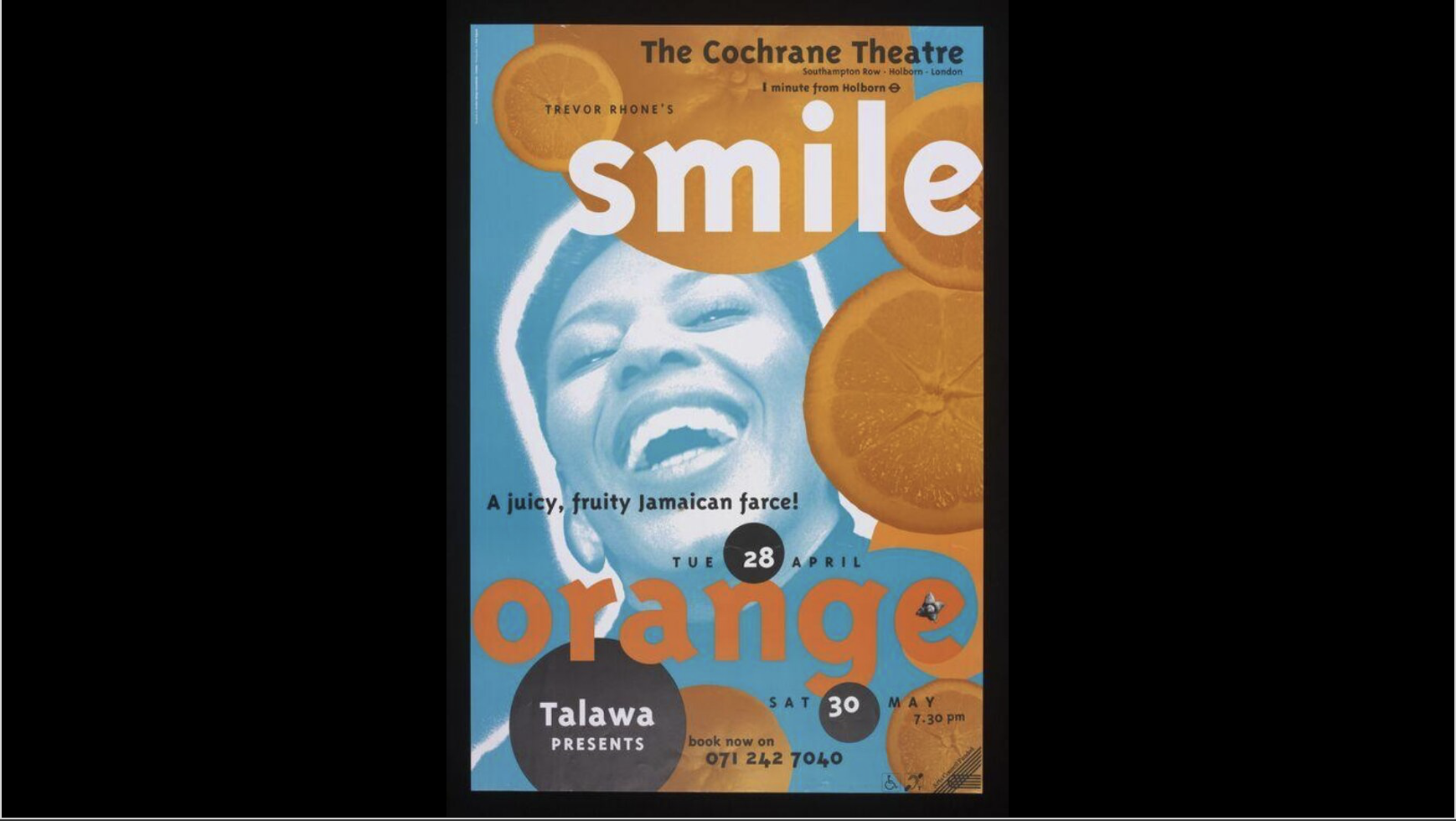
Poster for Trevor Rhone’s Smile Orange
The first thing to say is that the centre of this world is a globalized underclass – I use the term advisedly, since many of these people are not adequately described as ‘working-class’ in the sense of being part of the proletariat. From the drivers in Soyinka’s The Road to the service workers of the Jamaican tourist industry in Trevor Rhone’s Smile Orange and colonial underclass who dance Jonkonnu in Sylvia Wynter’s Maskarade to the various forms of lumpenproletariat, hustler existence in the American south in Ida Mae Holland’s From the Mississippi Delta, the Nigeria of Biyi Bandele-Thomas’ Resurrections and the Johannesburg of Paul Slabolepszy’s Mooi Street Moves, most of the plays Brewster programmed view the world from the standpoint of a racialized proletariat or sub-proletariat eking out their living along pathways shaped by the vectors of globalization in its various phases.
The plays in Talawa at the Cochrane’s repertoire that did not explicitly adopt the position of globalized underclasses were Michael Abbensetts’ The Lion, Ted Dwyer and Carmen E. Tipling’s musical Arawak Gold, Ntozake Shange’s collection of lyrical texts The Love Space Demands and Shakespeare’s King Lear.
The Lion depicts the ousted leader of a formerly colonized Caribbean island, discovering that – in his words – ‘when a black prime minister stops being a black prime minister, he’s just another black man’, so it certainly concerns itself with entanglements of race and class, but it would not be true to say that its protagonist finds himself within an underclass.
Arawak Gold narrates the initiation of colonization in the Caribbean and Americas from the standpoint of indigenous people, and thus engages the roots of the coloniality and globalization that produced a colonial and globalized proletariat and subproletariat. Although Shange’s texts do not concern themselves primarily with social relations, their political commitments are evidently those of materialist feminism.
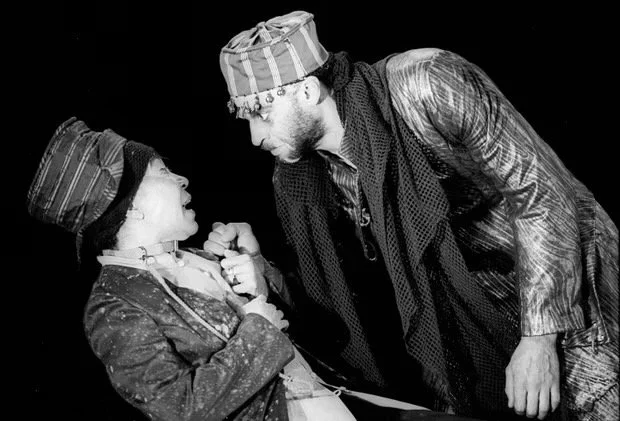
Mon Hammond as the Fool and Ben Thomas as Lear in Talawa’s King Lear
Turning to Lear, its original leading actor, Norman Beaton, had initially suggested that the King should be the head of a credit union that his daughters are stealing from, a social position that is notably congruent with the rest of Talawa’s Cochrane repertoire. Lear is also, of course, Shakespeare’s great tragedy of the collapse of social order and his best analogy for the ravages created when counterrevolutionary forces rushed into the momentarily open possibilities of decolonization. In spite of the staid traditions of its mainstream staging, in other words, the world of Lear is not at all far from that of the Nigeria, American south, Jamaica or South Africa of the other plays Brewster chose.
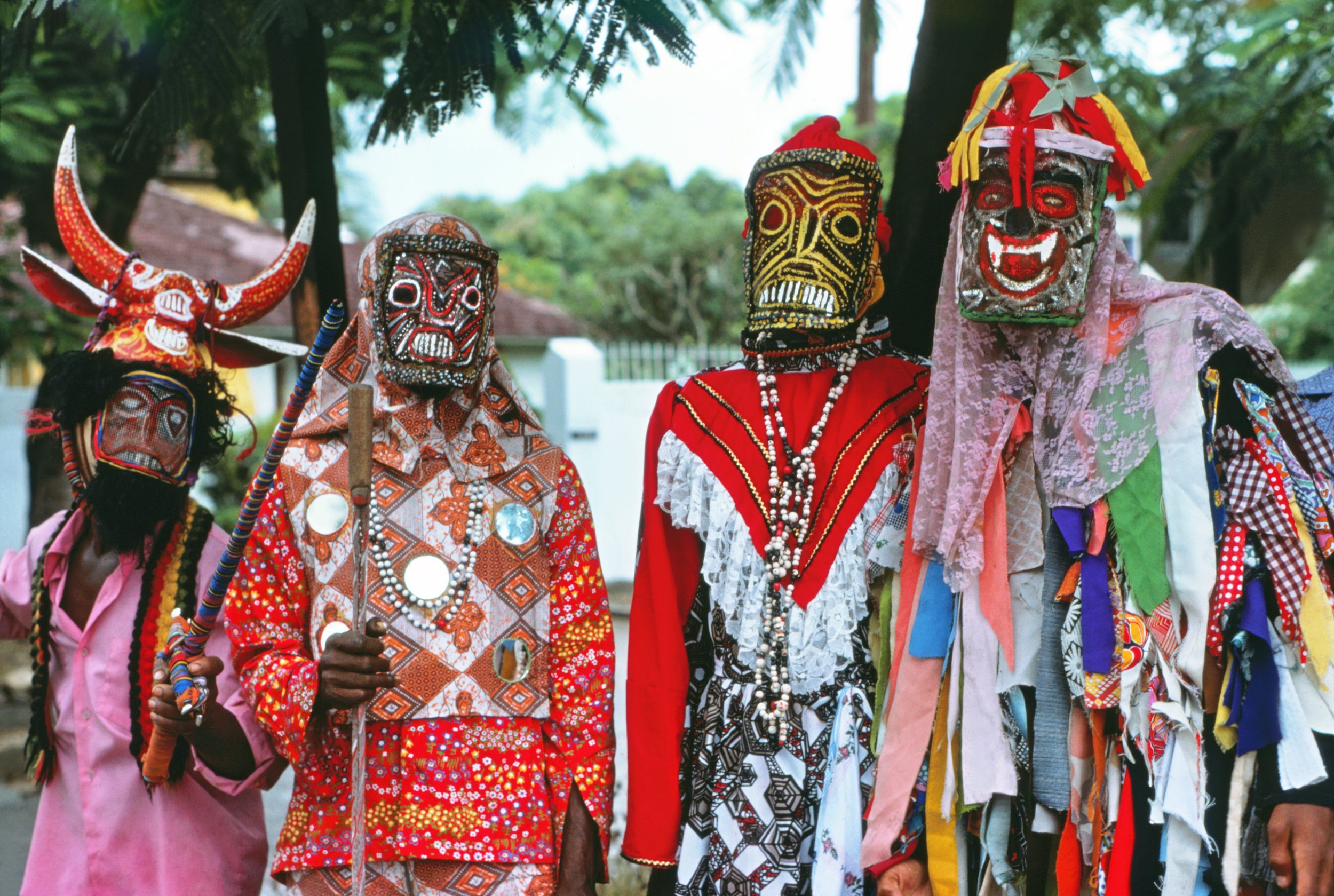
Jonkonnu performers
The prominence of Lear’s fool in Shakespeare’s play is also reflected in Wynter and Soyinka’s intertextual use of the vernacular traditions of African Caribbean and Yoruba performance in The Road and Maskarade respectively. Their plays’ use of ritual performances as dramaturgical frames constitutes an epistemic intervention that both critiques and displaces colonial forms of knowledge and frames vernacular performance and its myths as a basis for collective self-understanding.
Biyi Bandele’s Resurrections echoes Soyinka’s use of Yoruba cosmology and subversively deploys the ancestral ghosts of his protagonists in his critique of the tortuous legal systems of post-independence/neo-colonial Nigeria. The dialogue structure of Slabolepszy’s Mooi Street Moves is much more recognisably western in its form, but its demotic speech embodies the hustler knowledge of its central character who could have jumped – alongside Bandele’s drug dealers – straight off the pages of Fanon’s account of the colonial lumpenproletariat in The Wretched of the Earth.
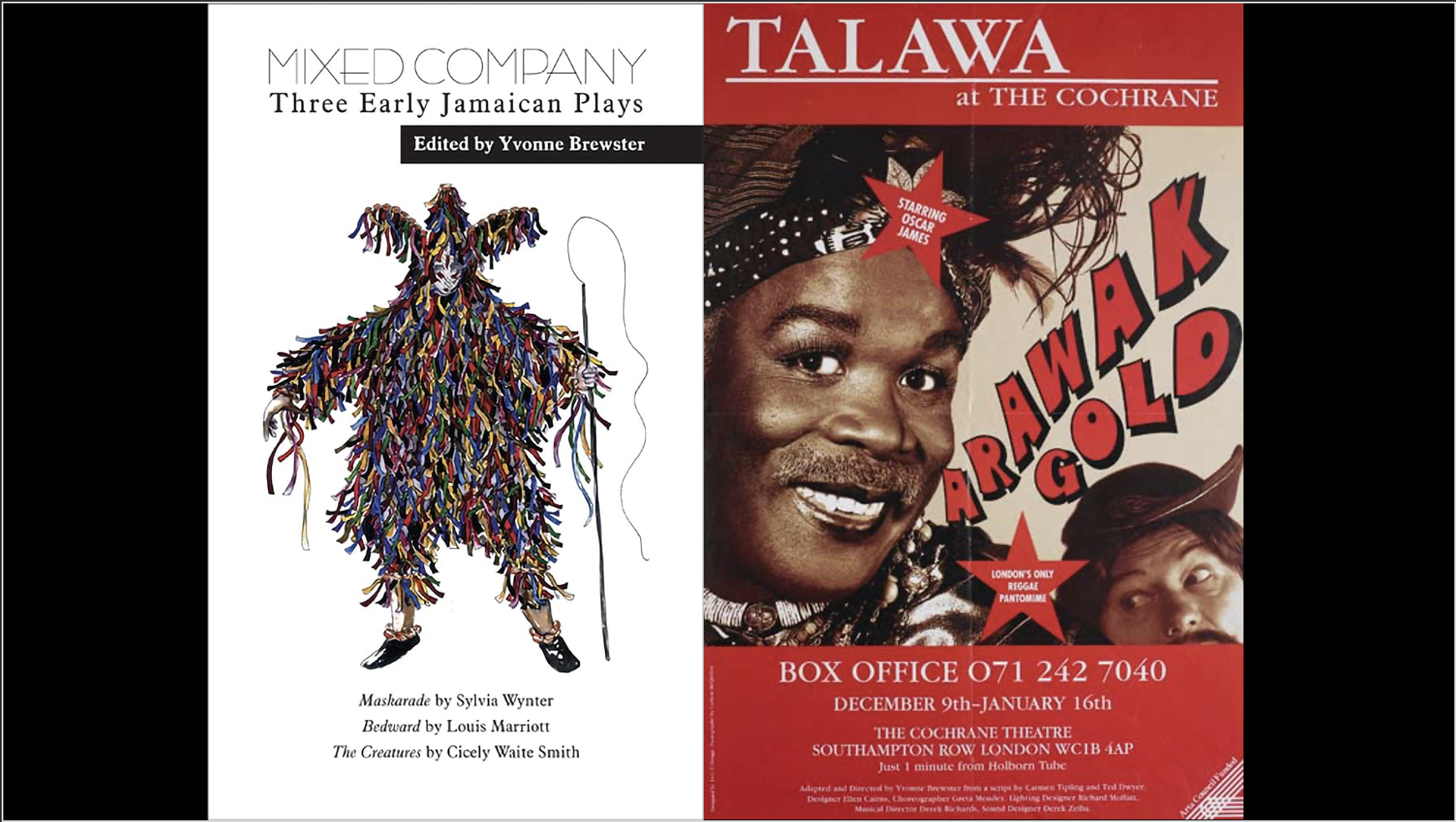
Cover of Three Early Jamaican plays and poster for Talawa’s production of Arawak Gold
Likewise, Wynter’s use of Jamaican patois signals a commitment to forms of knowledge born from struggle against colonial exploitation and domination. Wynter’s text goes so far as to suggest that the cultural practices and situated epistemologies of the Caribbean – particularly those of the Jamaican maroons – represent the indigenizing of Black people in the Caribbean. I would want to push back against her flattening account of indigeneity here by observing that many Zionists would find it easy to appropriate her her statement that: ‘roots are never natural; roots are created in a new relation to the land. This is what indigenizes you’.
Regardless of this over-reach, though, implicit and explicit assertions of solidarity between formerly enslaved and colonized and indigenous people represent an important political commitment of these plays.
In summary, then, Brewster’s repertoire for Talawa at the Cochrane constructs a world from the position of a globalized underclass, whose epistemologies both resist and cannot be encompassed by coloniality, and who are committed to solidaristic relations with indigenous people. (I expect you can see where I am going with this.)
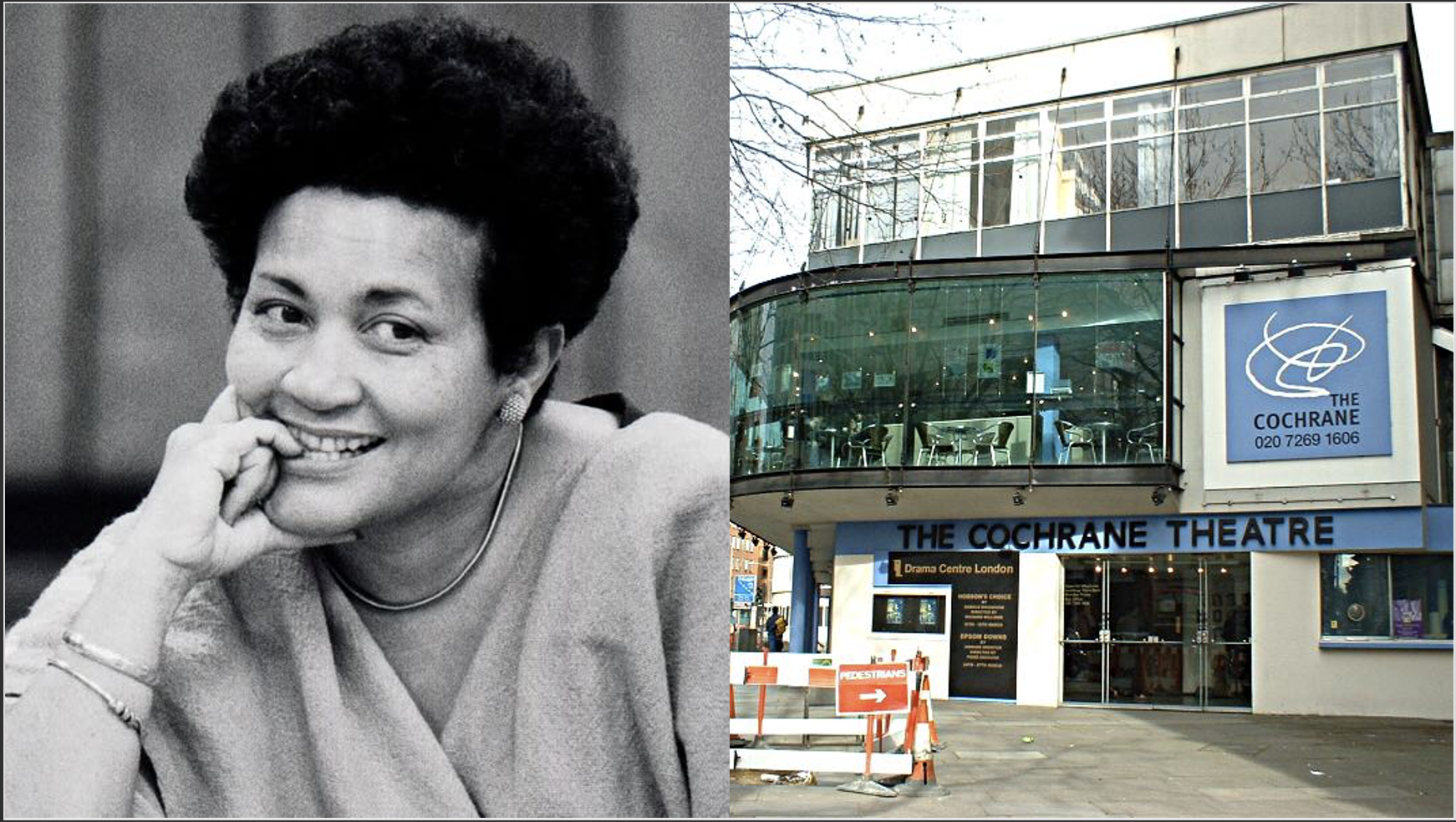
Yvonne Brewster and the Cochrane Theatre
Needless to say, apart from King Lear, none of these plays has had any kind of production history in Britain since Talawa at the Cochrane. Talawa has since been incorporated into Arts Council England’s National Portfolio and established a home at Fairfield Halls, but this repertoire, its standpoints, aesthetics and solidarities have been excluded from British cultural production. That is incorporative exclusion in action.
From a political perspective, it is striking that what has been structurally excluded in that process, most fundamentally, was the possibility of Black and other racially minoritised people conceiving of and constituting themselves outside the ontological and epistemological frameworks of the imperial core.
Where imperialism assumes its cultural superiority, these plays frequently provincialize white European culture by giving dramaturgical primacy to the cultural forms of colonized people, which they do not explain for a white audience. Where European forms are used, as in Trevor Rhone’s Smile Orange, we see them turned against white Europeans, who become problems to be navigated by the protagonists – most strikingly in the objectified form of the corpse of a white man whose death by drowning has to be explained away. The hotel staff in Smile Orange, like the lawyers and drug dealers navigating the contorted absurdities of the Nigerian legal system in Biyi Bandele’s Resurrections, and Stix, the Black hustler in Paul Slabolepszy’s Mooi Street Moves, also variously function to denaturalize imperial hierarchies, expose the arcane and surreal means by which they are imposed and maintained, and celebrate the ingenuity with which they can be side-stepped and subverted.
In other words, these plays actively worked to resist imperialism’s combined project of classification and domination. They frequently either bypass or subvert its categorical systems and stage the erosion or collapse of its capacity to subjugate. The timing of this intervention was significant not only insofar as it occurred at a moment of crisis for a racial regime that was struggling to sustain the segregation of culture. It also staged alternatives to capitalist imperialism as an ongoing world-making (and world-destroying) project at precisely the moment of that project’s formation as unipolar US-led imperialism.
American imperialism has focused, since the early 1990s, crucially on establishing hegemony in west Asia and north Africa, through direct military interventions, the imposition and maintenance of friendly regimes, and the normalization of the Zionist entity in Palestine. We can think of this as the geo-political manifestation of a revolution in global capitalism, that produced what Sivanandan called ‘new circuits of imperialism’. Sivanandan’s writings from the late 80s and early 90s offer strikingly prophetic accounts of the shift in global capitalism away from ‘heavy labour-intensive industries’ in the west and towards the global periphery where there were ‘enough cheaper and captive labour reserves … for capital to move around in, discarding each when done’. Sivanandan’s emphasis on changes to production processes that offered capital much more freedom from ‘spatial strictures’ and on ‘changes in … the productive forces’ that meant that data ‘increasingly replaces labour as a factor of production’ explain a great deal today. Racisms of the border, civil wars in regions predated for mineral resources upon which data depends, the struggle for control of the Strait of Hormuz, and the unleashing of the full genocidal force of coloniality in Gaza and south Lebanon can all be traced back to the ‘new circuits of imperialism’.
While Brewster’s repertoire did not directly address this phenomenon, which was only emergent at the time, it did equip audiences with a framework to think through the ways in which racially-minoritised populations in the imperial core are structurally entangled with newly constituted underclasses in its peripheralized regions. It offered, in other words, a basis for directly connecting domestic racisms and the global project of imperial capitalism. This is essential if we are to understand how to think relationally today about race riots in Portsmouth, expulsions of migrants from South Africa, genocidal Zionism, Hindutva pogroms in India, and – on the other side of the coin – about the political power that has been mobilised by the Indigènes de la Republique in France.
The racial regime that seems poised to emerge in contemporary Britain is deeply entangled with the violent and chaotic crisis of imperialism at a planetary scale. For me, Yvonne Brewster’s legacy to 2026 is that she treated the production of culture as an opportunity to contest the terms of the racial regime and expose not only its tattered patchwork, but the interests that it is so desperate to obfuscate and conceal. Talawa’s residency at the Cochrane exemplified her technique of claiming the state’s resources and using them to undermine its authority, reject its terms and values, and instantiate her own agenda. She taught us, in other words, how to work in and against the imperial state.