Call for contributions: Special Issue on ‘Antiracism after 2020: Cultural Production and Counterinsurgency’
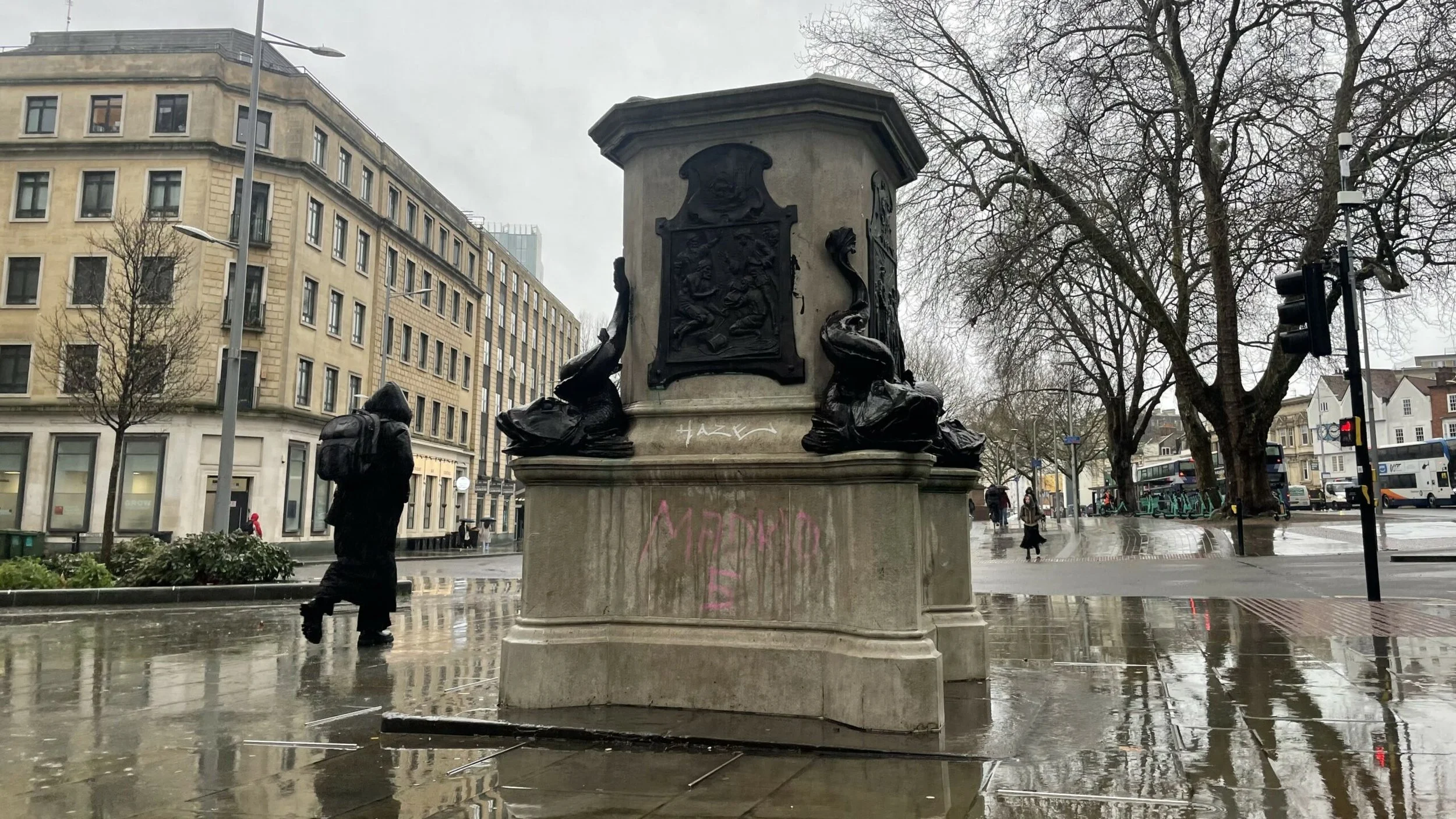
On a grey and rainy day, a person with their back turned walks past the empty plinth in central Bristol that once carried an image of Edward Colston cast in bronze (photo by Martin Booth).
Call for contributions: Special Journal Issue to be edited by Roaa Ali and Tom Six
The European Journal of Cultural Studies is provisionally interested in publishing the following special issue, subject to confirmation in April 2026. We are seeking proposals for research articles (7-8000 words), shorter articles and book reviews aligned with the following overview.
The year 2020 seemed to produce a rare opportunity for a pivotal rupture in western racial order. The filmed murder of George Floyd catalysed antiracist insurgencies that, under the exceptional circumstances of a global pandemic, unsettled longstanding racialised hierarchies across social, political, and cultural domains. Critiques of the criminal justice system, borders, education, corporations and cultural organisations that had been gathering in strength in the wake of the global financial crisis of 2007-8 were suddenly accelerated into broader public consciousness. This did not, of course, happen spontaneously. Rather, activists were able – briefly, at least – to exploit an extremely unusual combination of factors. First, there was an unprecedented near-global pause in much of the business-as-usual of life in the slow collapse of global capitalism’s neoliberal phase. The spaces created by this pause proved fertile sites for the growth of widespread outrage at the ways that Floyd’s murder spectacularly exemplified the mundane cruelty and extreme violence of racism. This outrage proved to be a spark to the insurgent fuel of a widespread longing to take to the streets both to break the insularity and act upon the solidaristic potential engendered by the pandemic. As a result, in the west, corporations and state institutions found themselves suddenly on the back foot. Black squares were posted to Instagram, reports were commissioned and action plans drawn up, the agendas of equalities committees swelled, antiracist training was mandated, terminology was altered, minorities were consulted. Many of these measures were swiftly dismissed as ‘performative’ or, as Sara Ahmed (2006) more precisely theorises, ‘non-performative’ actions, signalling commitment to diversity without enacting structural change—a by-now familiar refrain in the critical literature on the subject (Ahmed, 2012; Ali and Byrne, 2023). As Anamik Saha (2018) observes, however, while diversity policies are fraught with contradiction and often reproduce racial hierarchies, they can also generate disruption, and thereby produce moments that activists and cultural workers may tactically exploit to push for more substantive antiracist change. 2020 functioned, then, as a spanner in the works of white supremacist normality, and, even under neoliberal constraints, created an inflection point for antiracist insurgency.
From the vantage point of 2025, however, that insurgent potential has found itself overwhelmed by a powerful counter-movement. The “anti-woke” backlash has not only grown in strength, but become hegemonic, with far-right discourse propagated ever more energetically by mainstream political and cultural institutions (Mondon and Winter 2020; Brown, Mondon and Winter, 2021). As Gavan Titley reminds us (2020), racism today is less a pathology than a public pedagogy, constantly being reproduced through debates about who can speak, belong, or even matter in the polity. The post-2020 backlash has targeted equality, diversity and inclusion initiatives as symbols of an alleged ‘liberal overreach’, turning antiracism itself into an object of suspicion and a terrain for counterinsurgent capture. Corporations are making redundant many EDI roles; governments are dismantling welfare protections and hardening migration regimes. This backlash against the rise of liberal antiracism a decade ago is now in full swing. It has even absorbed many voices on the broad left, whose critiques of liberal identitarianism and calls for a return to solidarity rooted primarily in a class-based analysis of power have increasingly been framed as a further iteration of the rejection of ‘identity politics’ (Richmond and Charnley 2022), with disastrous consequences for any attempt to break the racial state (Bouteldja 2024). The roots of these tendencies in the resurgent far-right does not seem to have alerted many who claim vehemently to oppose fascism to the dangers of their politics becoming articulated with it, suggesting that the backlash has shifted from an emergent feature of our politics to a dominant theme. What might have been minimised as an ‘anti-woke backlash’ seems, in other words, to have become hegemonic. Indeed, as Alana Lentin (2025) argues, drawing on Cedric Robinson, what we have seen recently is the emergence of a ‘new racial regime’, in which antiracist and decolonial discourse is both attacked and celebrated, always in the interests of globalized racial capitalism.
And yet movements for liberation persist. Abdaljawad Omar writes of Palestinian resistance as ‘a form of epistemological insurgency … that dares to say: the world must be otherwise’ (2025). In a similar vein, Damani J. Partridge (2022) argues that Blackness operates as a universal claim on freedom and justice, unsettling both white liberal benevolence and far-right racial orders that seek to contain or erase it. Robin D.G. Kelley likewise argues that the post-2014 upsurge of solidarity between Black and Palestinian activists was driven by ‘a vision of worldmaking rather than a politics of analogy or identity’ (2019). We might therefore characterise antiracism since 2020 as a political project that has been clarified by a serious setback. Writing in a similar moment for the all-but-defeated Anglo-American left, Stuart Hall (1988) reflected on the position of Antonio Gramsci in the 1920s, soon after the ‘proletarian moment’ in world history had seemed to stall just as it was beginning to take hold. What Gramsci recognised, however, Hall argued, was that it had done no such thing. History had simply taken a different course: ‘When a conjuncture unrolls, there is no ‘going back’. History shifts gears. The terrain changes. You are in a new moment’.[1] This special issue takes the position that – in 2025 – we find ourselves, likewise, witnessing the unrolling of a new conjuncture, with all of the clarifying force of such moments, and the concomitant risk of defeatism, disengagement and despair.
Looking from this moment of dominant counterinsurgency both to the recent past and potential futures, we ask what antiracist cultural production can teach us about our present. How did we arrive at this point? How has what Arun Kundnani called ‘the racial constitution of neoliberalism’ (2021) been rearticulated in a period of overlapping crises—financial, geopolitical, and ecological? What role have forms of antiracism played in securing a new racial regime in this process? How were antiracist insurgencies in western imperialist states so effectively tamed or bound to the reproduction of global white supremacy? And where, on the other hand, has this counterinsurgent project been effectively disrupted? What forms of world-making have emerged as alternatives both to the existing capitalist-imperialist world-order and to the resurgence of ethnonationalism and proto-fascism? Authors are invited to interrogate these questions across a range of cultural forms and geohistorical contexts in Euro-America, drawing on race critical scholarship (Goldberg 2009, Lentin 2020, 2025, Titley 2020, Partridge 2022, Saha 2018) to examine how interventions in cultural production expose, navigate, or are subsumed by contemporary racial orders. Collectively, contributions to this special issue will trace the contours of our present, mapping the contested terrain of cultural production in the wake of antiracist insurgencies and their backlash, while identifying common features and anomalous particularities across Euro-American contexts.
Proposed timetable
January 31, 2026: deadline for proposals to be submitted to roaa.ali@manchester.ac.uk and tom.six@cssd.ac.uk
February 20, 2026: authors notified of decisions
March 20, 2026: deadline for final abstracts to be sent for EJCS proposal
September 4, 2026: deadline for drafts to be submitted to special issue editors
October 2, 2026: editors’ feedback sent to authors
January 15, 2027: deadline for revised drafts to be submitted to journal for peer review